BALI – The Bali Provincial General Elections Commission (KPU Bali) is strengthening data integration and distribution planning to improve the accuracy, efficiency, and accountability of election logistics management through the development of the Logistics Information System (SILOG) 4.0.
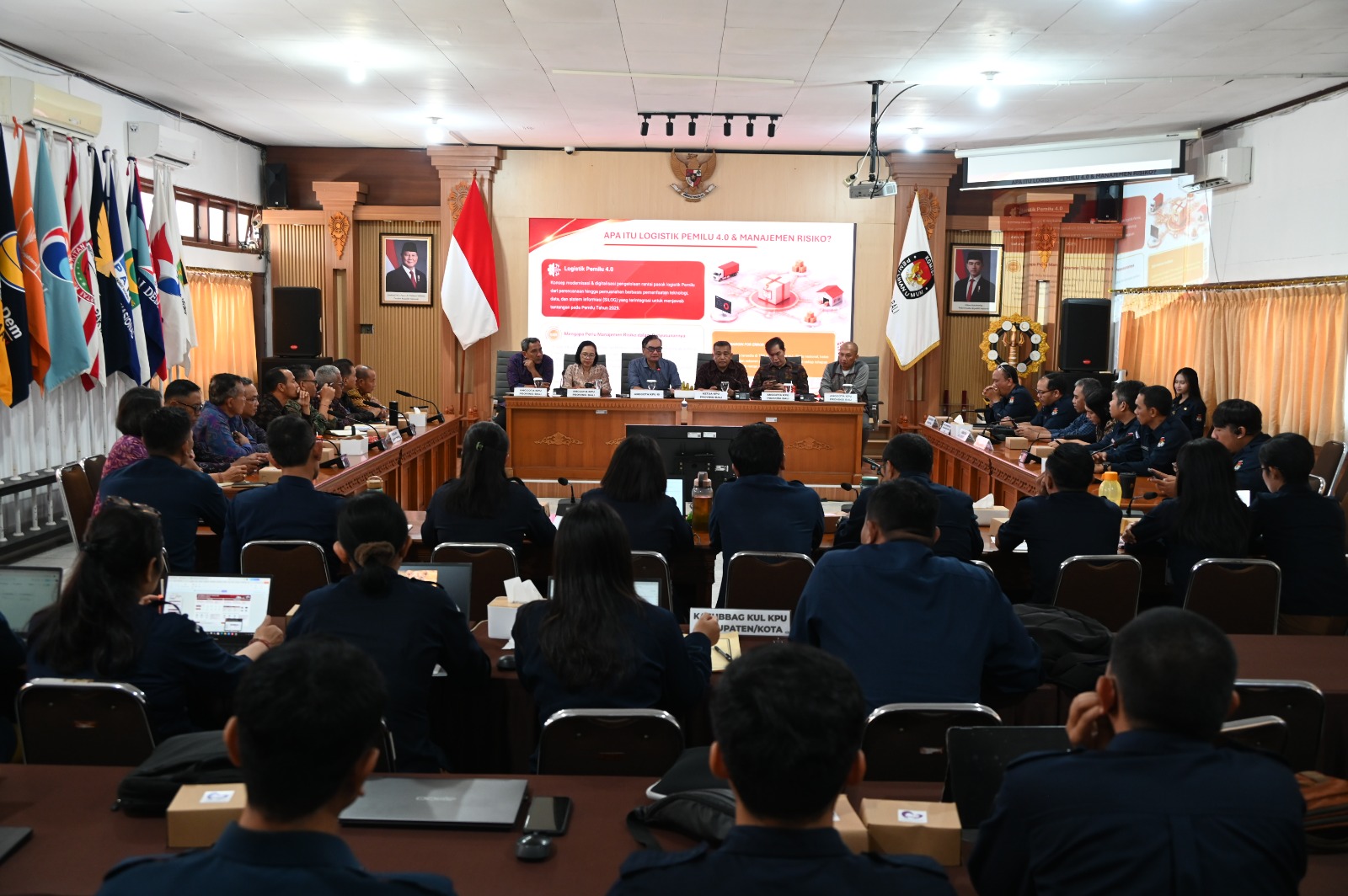
The initiative was discussed during a Focus Group Discussion (FGD) on Mapping Election Logistics Management and Distribution in Bali Province, held at the Bali Provincial KPU office on Tuesday, October 20, 2026. The mapping exercise is intended to serve as preliminary data for the development of SILOG 4.0.
The meeting was opened by Bali Provincial KPU Chair I Dewa Agung Gede Lidartawan and attended by KPU Republic of Indonesia member Yulianto Sudrajat, Bali Provincial KPU commissioners and secretary, district and municipal KPU secretaries, representatives of the Bali Provincial National Unity and Political Affairs Agency (Kesbangpol), and other KPU staff.
Bali KPU Maps Election Logistics Based on 2024 Experience
Lidartawan explained that Bali KPU had prepared preliminary data on election logistics management based on its experience during Indonesia’s 2024 simultaneous general and regional elections.
Bali KPU has also mapped distribution routes across regencies and municipalities, including delivery sequences, vehicle requirements, estimated transportation costs, and inter-island transportation needs.
The mapping is expected to support the development of SILOG 4.0 and help establish more measurable distribution plans tailored to Bali’s geographical conditions and the operational requirements of each area.
The commission is also examining alternative approaches to logistics management to identify more effective and budget-efficient operational procedures.
KPU RI Emphasizes Accurate and Timely Election Logistics
KPU RI member Yulianto Sudrajat welcomed Bali KPU’s initiative to prepare logistics data and distribution maps as input for developing SILOG 4.0.
He emphasized that election logistics management must meet three fundamental principles: the correct quantity, the correct type, and delivery at the right time.
According to him, lessons from Indonesia’s 2024 simultaneous elections should serve as a foundation for building a more professional, modern, and integrated logistics management system.
During the discussion, Head of the Logistics Documentation and Maintenance Division Adrian Aditya Nagara and KPU RI expert staff member Ikhwanudin also contributed insights on logistics needs planning, inventory management, and distribution risk mitigation.
Data Validation and Distribution Risk Mitigation
The discussion highlighted the importance of validating data at every stage of election logistics management, from receipt and sorting to folding, packing, and distribution.
Any discrepancies in quantities must be traced through documented records and inspection results to ensure that shortages are handled accurately and transparently.
Distribution planning also needs to incorporate geographical data, travel distances, vehicle requirements, estimated journey times, and the identification of areas requiring special handling.
In Bali, these considerations are particularly relevant to distribution planning across different geographical conditions, including areas that require inter-island transportation.
Participants also highlighted the importance of improving warehouse management, standardizing operational procedures, and strengthening staff competencies as part of efforts to enhance SILOG 4.0.
SILOG 4.0 Expected to Strengthen Accountability Across Bali
Through the FGD, Bali Provincial KPU hopes that the preliminary data and distribution maps it has prepared will make a practical contribution to the development of SILOG 4.0.
The integrated system is expected to preserve institutional knowledge, improve operational efficiency, and strengthen orderly and accountable election logistics management across all levels of the KPU organization.
The initiative forms part of Bali KPU’s commitment to supporting more professional election administration and ensuring that election materials are available where and when they are needed to serve voters effectively.