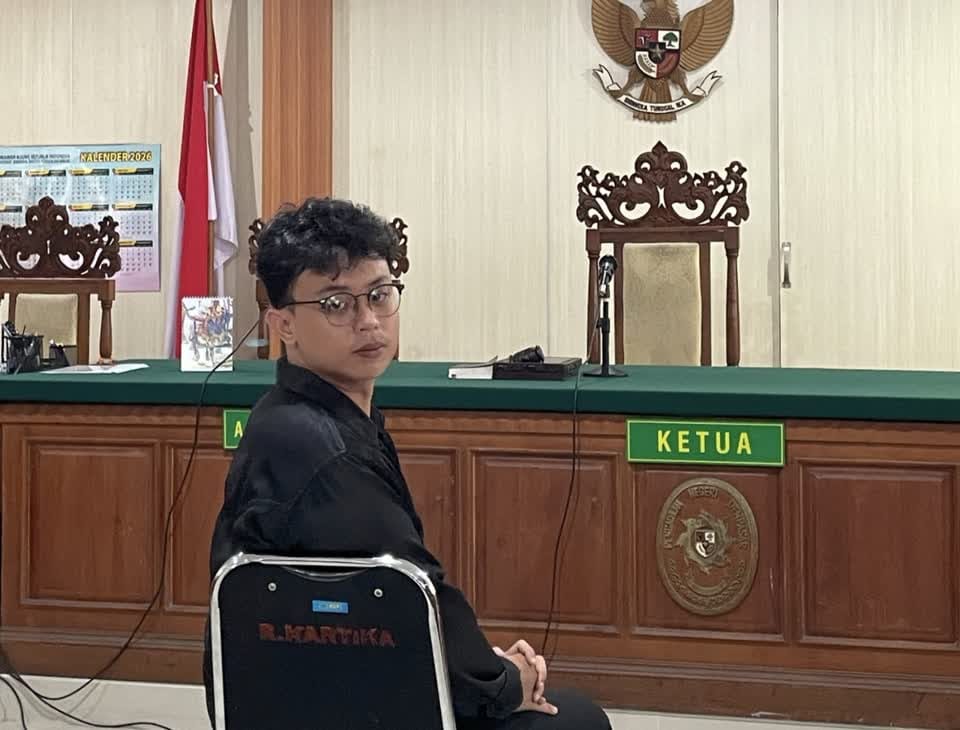
BALI — The Denpasar District Court has found Tomy Priatna Wiria guilty of incitement in connection with an August 2025 protest in Bali. In Decision No. 247/Pid.Sus/2026/PN Dps, the panel of judges sentenced Tomy to nine months of probation.
The verdict has drawn criticism from the Bali Advocacy Coalition for Democracy, which considers the decision part of a broader series of injustices allegedly experienced by Tomy and members of the public following the 2025 demonstrations.
According to the coalition, the case began when members of the public exercised their constitutional rights to express criticism through peaceful channels but were subsequently confronted with violence and criminal proceedings by law enforcement authorities.
The coalition argues that the court's decision has further legitimized what it describes as the criminalization of critical voices, rather than providing judicial protection for freedom of expression and human rights.
The coalition maintains that the conviction does not meet the requirements for establishing criminal liability. It argues that the distribution of a consolidation poster did not constitute a criminal act and that there was no evidence demonstrating that Tomy intended to encourage others to violently resist public authorities.
The coalition therefore argues that the court failed to properly establish both the criminal act (actus reus) and the element of criminal intent or culpability (mens rea/schuld).
According to the coalition, the verdict consequently conflicts with the principles of legality and no punishment without fault.
The coalition also criticized the court for allegedly disregarding evidence presented during the trial concerning the treatment of witnesses and Tomy during the investigation and detention process.
The coalition claims that several witnesses testified that statements recorded in the investigation documents, or BAP, had been obtained through intimidation and alleged mistreatment.
Some witnesses, according to the coalition, withdrew their earlier statements, saying they had been obtained through pressure, intimidation, or alleged coercion by investigators.
The coalition argues that evidence obtained unlawfully should not be used as the basis for a criminal conviction. It also alleged that Tomy experienced a series of human rights violations during the legal process, including alleged procedural violations during coercive measures, restrictions on access to legal assistance, as well as intimidation, pressure and violence during examination and detention.
The coalition further stated that evidence presented in court showed alleged violence and other violations of law involving hundreds of demonstrators.
A central issue raised by the coalition concerns the legal interpretation of incitement.
The coalition argues that the judges failed to properly consider incitement as a material offense, referring to Constitutional Court Decision No. 7/PUU-VII/2009.
According to the coalition, evidence presented during the trial showed that acts of property destruction occurred spontaneously after individuals witnessed the situation at the protest site. The coalition said there was no evidence demonstrating that the destruction had been planned in advance as a result of the narrative contained in the consolidation poster.
One witness, the coalition said, testified that the person acted merely by following others and was unaware of the consolidation posting until investigators showed it during the investigation.
Based on these circumstances, the coalition argues that no causal connection was established between Tomy's poster and the subsequent acts of destruction.
The coalition emphasized that a temporal connection between two events does not automatically establish a causal relationship.
The coalition also criticized the judges for allegedly failing to adequately consider testimony from experts presented by Tomy's legal team.
Constitutional law experts Bivitri Susanti, S.H., LL.M. and Prof. Dr. I Dewa Gede Palguna, S.H., M.Hum. reportedly explained that the consolidation poster constituted an expression and an invitation to gather, rather than an invitation to commit a criminal offense.
They also explained that restrictions on freedom of expression should be assessed by considering factors including context, intent, content, dissemination and the likelihood of harm.
Criminal law expert Dr. Ahmad Sofian, S.H., M.H., meanwhile, emphasized that a causal relationship between the consolidation activity and a criminal incident must first be established.
The coalition also questioned the relevance of several seized items used as evidence, arguing that their use allegedly expanded the scope of the evidentiary process beyond the criminal offense charged against Tomy.
The Bali Advocacy Coalition for Democracy said it regretted the Denpasar District Court's decision, arguing that the ruling failed to adequately uphold constitutional guarantees protecting freedom of expression. The coalition also argued that the verdict disregarded constitutional interpretations concerning incitement and overlooked facts that it considers clearly established during the trial.
According to the coalition, testimony from witnesses and experts indicating the absence of a causal relationship between the consolidation poster and the acts of destruction was not given sufficient consideration. The coalition said the ruling instead reinforced a criminal case that it had considered problematic from the outset.
It concluded that rather than correcting what it describes as the criminalization of critical voices, the Denpasar District Court's decision has provided further legal legitimacy to the process.