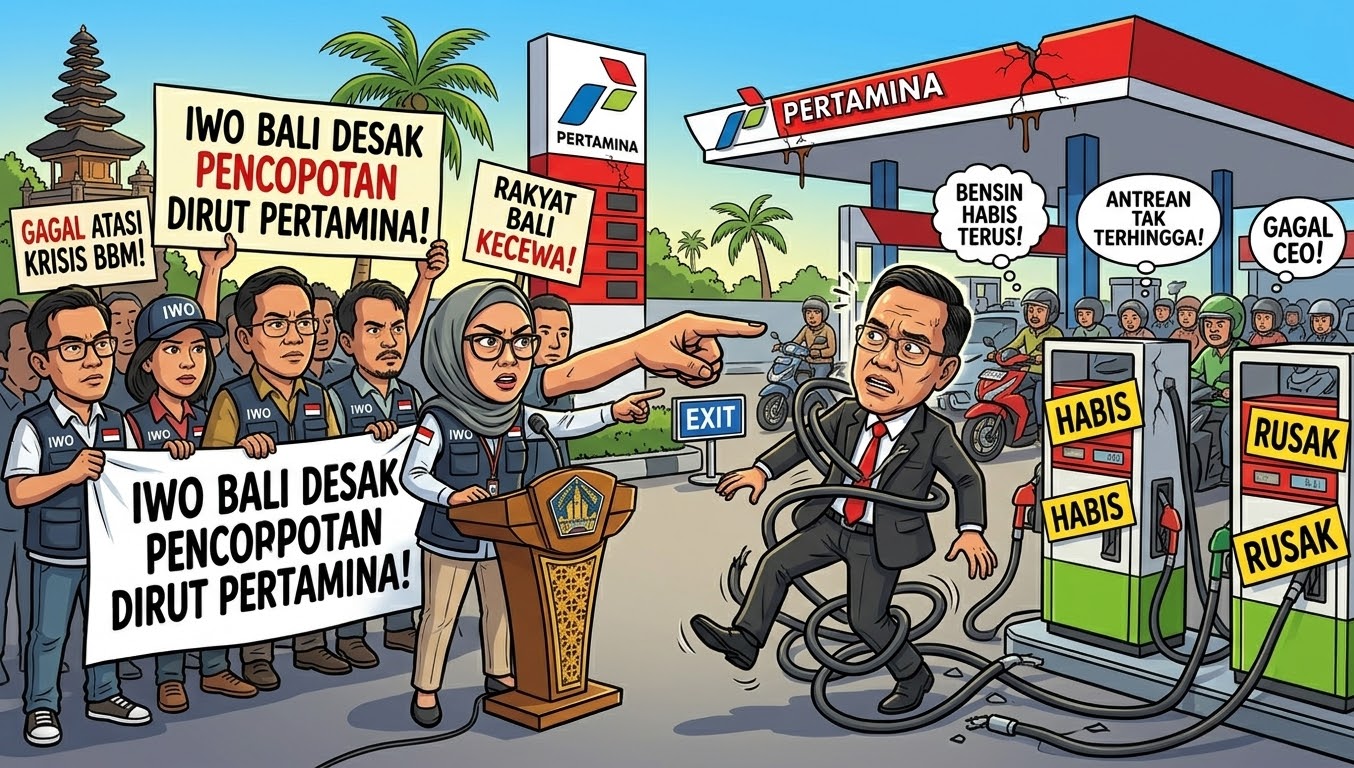
BALI – Indonesian Online Journalists Association (IWO) Bali has urged state-owned energy company PT Pertamina to take immediate, concrete action to address fuel shortages across Bali, as residents grow increasingly frustrated with long queues at petrol stations.
Tri Widiyanti, chairperson of PW IWO Bali, said Pertamina's assurances that fuel stocks remain available were insufficient while motorists continued to struggle to obtain subsidized Pertalite and non-subsidized Pertamax. She called on the company to ensure that fuel supplies actually reach petrol stations and are accessible to the public.
Tri Widiyanti, widely known as Widy, described reports of vehicle queues stretching hundreds of metres and, in some locations, more than two kilometres as a serious concern.
The disruption has affected daily mobility and threatens worker productivity, business operations, goods distribution and Bali's tourism sector, which relies heavily on reliable transportation.
Residents, she said, should not have to bear the consequences of unresolved supply and distribution problems without clear explanations from the company responsible.
“People need fuel to work, earn a living, run businesses and serve tourists. Pertamina must provide solutions, not just statements,” she stressed.
Bali Journalist Misses Assignment Amid Fuel Shortages
The impact of the fuel shortage has also been felt by journalists working in Bali. Ayu Afria UE, a journalist with Indonesian news outlet IDN Times, said she was forced to miss a reporting assignment on Tuesday after struggling to find fuel since the previous evening.
Ayu said she had difficulty obtaining not only Pertalite but also Pertamax and Pertamax Turbo, the types of fuel she normally uses. She visited four petrol stations before finally finding fuel.
“I went to four different petrol stations, and none had fuel available, even though I don't use Pertalite. I use Pertamax or Pertamax Turbo,” she said.
Based on her observations, queues at several petrol stations stretched approximately 800 metres, while the queue along Jalan Imam Bonjol was estimated to exceed two kilometres.
Ayu also recounted her experience at a petrol station in the Teuku Umar Barat area. While motorists were still queuing, staff reportedly stopped service after saying Pertamax had run out. However, the station resumed refuelling operations almost two hours after she had left.
After visiting several locations, including Sunset Road and an area near Bali's airport, she eventually found fuel at a petrol station near McDonald's Pura Demak.
The lengthy search caused her to miss the opening of Climate Week at Prama Sanur. Finding alternative transportation was also difficult: ride-hailing services were hard to book, while an electric taxi driver she interviewed said demand had become overwhelming.
After informing her newsroom about the situation, Ayu decided to monitor developments from home.
Her experience highlights how fuel shortages can directly disrupt people's livelihoods, including journalism, a profession that often requires frequent travel to cover events and gather information.
Ayu expressed hope that residents would not face continued difficulties obtaining fuel, stressing that reliable mobility is closely linked to economic activity.
She also questioned the lack of clear public information about the causes of the shortages, which she said appeared to have persisted for several months. Without timely explanations, uncertainty could encourage excessive purchasing or panic buying.
IWO Bali Calls for Transparency on Fuel Supply Problems
Responding to the situation, Widiyanti called on Pertamina to publicly explain the causes of the shortages, distribution bottlenecks, Bali's actual fuel requirements and the timeline for restoring normal supplies.
She questioned the apparent gap between official assurances of adequate fuel stocks and the difficulties residents continued to experience at petrol stations across the island.
“If stocks are available and the problem is only distribution, where exactly is the bottleneck? What is happening along the distribution chain, what are Bali's actual fuel requirements, and when will supplies return to normal?” she asked.
IWO Bali also urged Pertamina to clarify public concerns and circulating claims about the possible discontinuation of Pertalite. According to Widiyanti, unclear information during a period of limited fuel availability could intensify public anxiety.
The association called for faster distribution of Pertalite and Pertamax, particularly to areas experiencing the longest queues. Pertamina should also provide transparent updates about supply constraints and recovery schedules so residents and businesses can plan their activities with greater certainty.
“Do not wait until queues grow longer, economic activity is disrupted or public trust deteriorates. We urge Pertamina to take concrete action immediately and restore normal distribution as quickly as possible,” Widiyanti said.
Local Government Urged to Strengthen Oversight
In addition to calling on Pertamina to act, Widiyanti urged local governments and relevant agencies in Bali to strengthen oversight of fuel distribution to ensure that households and businesses can meet their needs during the disruption.
She warned that the fuel shortage should not be treated merely as a problem of long queues. If it continues, it could disrupt workers, business operations, goods distribution and services for tourists, an important part of Bali's economy.
IWO Bali stressed that the public needs clear answers about the causes of the shortages and when fuel distribution will return to normal, rather than repeated assurances that stocks are available.
“Do not keep saying that fuel stocks are secure while people are still struggling to find fuel. Pertamina must demonstrate real action. The measure is simple: fuel must be available at petrol stations, queues must decrease, and people must be able to resume their normal activities,” Widiyanti concluded.